Astronomers have spent decades scouring the universe for signs of life and come up empty-handed – but what if they were simply looking the wrong way?
Scientists argue that extraterrestrials may be out there, but we have been overlooking, missing, or ignoring possible evidence.
The researchers call this the problem of ‘false negatives’, and say that it could be holding back the search for life beyond Earth.
These false negatives may mean there are signs of alien life out there, but we haven’t been able to detect them yet.
Lead author Professor Inge Loes ten Kate, an astrobiologist from Utrecht University and the University of Amsterdam, told the Daily Mail that experts should be on the lookout for this issue.
She explained that scientists could miss the signs of life when their equipment isn’t up to spotting them.
However, she also warns that evidence for alien life might be slipping right under our noses because scientists simply aren’t prepared to consider the possibility.
Professor ten Kate says: ‘We miss it or misinterpret it because we think it is “just a mineral” or “just a gas in the atmosphere that is not produced by life”‘.
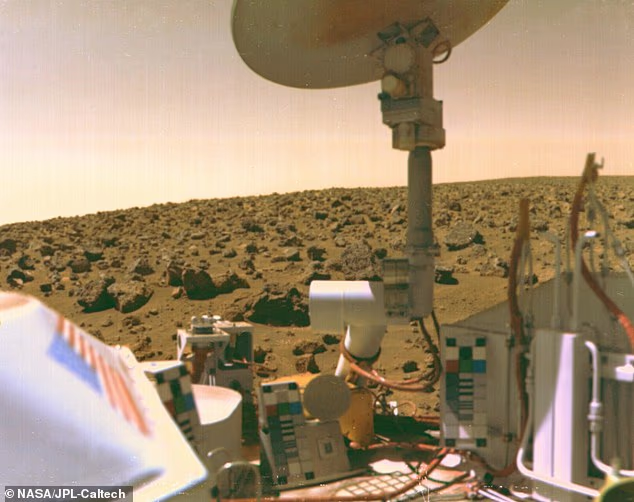
Scientists say that humans might have already found alien life, but simply ignored the evidence in a ‘false negative’ error. Pictured: Images of the Martian surface taken by the Viking rover, which experts say may have missed vital evidence
Astrobiology, which is the science of looking for life beyond Earth’s atmosphere, is usually more concerned about false positives than false negatives.
In their paper, published in Nature Astronomy, Professor ten Kate and her co-authors say this is due to the massive risk of scientists declaring they’ve found life too early.
A false positive might undermine the public’s trust in science or even put funding for future research in jeopardy.
This has led to the potential risks of false negatives being largely overlooked, which creates major ‘shortcomings’ in the search for life.
If scientists decide that a planet is lifeless too early on in their search, they might miss out on finding new evidence or lose funding for equipment that could have found it.
Even on Earth, assumptions about where life is possible has led scientists to overlook viable habitats.
For example, researchers have discovered microorganisms beneath the rocks in Antarctica’s Dry Valleys.
But since these were below the surface, it had previously been assumed that no life that uses photosynthesis to feed would be possible.

NASA’s Viking Biology Test previously concluded that Mars had no biological molecules (illustrated), but we now know the test was compromised by elements in the soil. This means we might have missed evidence of life
Similarly, methods currently used to look for life on distant planets would likely miss these subterranean organisms, as well as the vibrant ecosystems that surround deep ocean vents.
Another big assumption that could be leading to false negatives is the belief that, if life exists, it should be relatively abundant enough to produce big observable changes.
However, the researchers point out that there is no reason to assume that a slow-growing alien form of life would rapidly colonise an entire planet.
So, when scientists see that a planet lacks obvious signs of life and quickly move on, they risk ignoring evidence for life that could be found with better tools and closer examination.
Professor ten Kate says there are currently two cases on Mars that she would reinvestigate as possible false negatives if money allowed.
The first is the Viking Biology Experiment, which was conducted by two NASA rovers in 1976.
The rovers ran a series of chemical tests on Martian soil and concluded that it didn’t have any biological molecules that would indicate the existence of life.
However, scientists now know that these rudimentary tests were likely corrupted due to a previously undetected salt in the soil.

NASA found minerals on the Martian surface (pictured) which are only created by biological processes on Earth. But without further study, scientists aren’t able to learn anything more about whether there really is life on Mars
Professor ten Kate says: ‘New research showed that a compound, perchlorate, was present that caused the Viking results, but at the time of Viking, we had no idea a compound like that could be present at all at the surface of Mars.
‘With everything we know now compared to then, we are able to redesign those experiments to give us answers that may be more indicative of life or no life.’
Another possible false negative is the recent discovery of the ‘poppy seeds’ and ‘leopard spots’ found by the Perseverance rover.
These are rings of iron-bearing minerals which, on Earth, are generally produced by biological activity.
In the context of Mars, scientists simply don’t know enough to form any strong conclusions about what is going on.
However, with NASA’s science budget slashed, the long-promised Sample Return Mission that would allow further investigation seems extremely unlikely.
‘It would be amazing if there were a sample return mission at some point to collect those samples, as our labs on Earth may give a clear answer,’ says Professor ten Kate.
The researchers are urging other scientists to focus on avoiding false negatives as well as false positives.

Scientists say that false negatives can be caused when our technology can’t spot the signs of life or when scientists make assumptions about what evidence should exist (illustrated)
To do this, scientists need to fully understand the environment they are looking at and try to think about which tests would reveal the specific life that might exist there.
While this will be easier for well-known planets like Mars than for less-understood environments like the icy moon Enceladus, progress is already being made.
‘The good news is that the intentions for this are already there and quite some research has been done in this direction,’ says Professor ten Kate.
‘Of course, some signatures we may always miss. For example, when searching from an orbit and there is life underneath a rock or in a cave, but even there, we may find some clues in the environments we can study.’
WHAT IS THE FERMI PARADOX?
The Fermi Paradox questions why, given the estimated 200-400 billion stars and at least 100 billion planets in our galaxy, there have been no signs of alien life.
The contradiction is named after its creator, Italian physicist Enrico Fermi.
He first posed the question back in 1950.
Fermi believed it was too extraordinary that a single extra-terrestrial signal or engineering project has yet to be detected in the universe — despite its immense vastness.
Fermi concluded there must a barrier that limits the rise of intelligent, self-aware, technologically advanced space-colonising civilisations.
This barrier is sometimes referred to as the ‘Great Filter’.

Italian physicist Enrico Fermi devised the so-called Fermi Paradox in the 1950s, which explores why there is no sign of alien life, despite the 100 billion planets in our galaxy
If the main obstacle preventing the colonisation of other planets is not in our past, then the barrier that will stop humanity’s prospects of reaching other worlds must lie in our future, scientists have theorised.
Professor Brian Cox believes the advances in science and engineering required by a civilisation to start conquering the stars will ultimately lead to its destruction.
He said: ‘One solution to the Fermi Paradox is that it is not possible to run a world that has the power to destroy itself.
‘It may be that the growth of science and engineering inevitably outstrips the development of political expertise, leading to disaster.’
Other possible explanations for the Fermi Paradox include that intelligent alien species are out there, but lack the necessary technology to communicate with Earth.
Some believe that the distances between intelligent civilisations are too great to allow any kind of two-way communication.
If two worlds are separated by several thousand light years, it’s possible that one or both civilisations would become extinct before a dialogue can be established.
The so-called Zoo hypothesis claims intelligent alien life is out there, but deliberately avoids any contact with life on Earth to allow its natural evolution.