William Brangham:
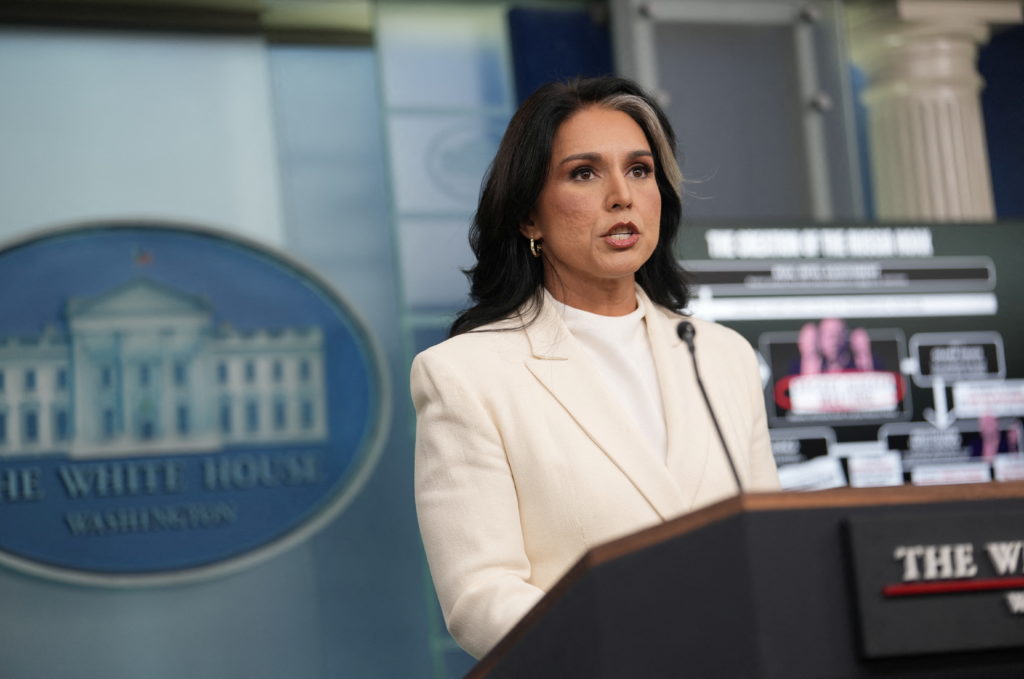
Director of National Intelligence Tulsi Gabbard, the highest-ranking intelligence official in the U.S. government, resigned today. She said her husband is suffering from a rare bone cancer that requires her full attention.
Foreign and defense correspondent Nick Schifrin and White House correspondent Liz Landers are both covering the story, and they join us now.
Nick, what did Gabbard say in her announcement, resignation announcement, today?
Nick Schifrin:
Well, as you said, William, Gabbard said that she’s leaving because of her husband’s illness.
And she released this resignation letter, which reads in part: “My husband, Abraham, has recently been diagnosed with an extremely rare form of bone cancer. I must step away from public service to be by his side and fully support him through this battle.”
In response, President Trump wrote that — quote — “Tulsi’s done an incredible job, and we will miss her.” And the president announced that her principal deputy, Aaron Lukas, would become the acting director of national intelligence.
And so the president using kind words there, William. And Tulsi Gabbard has executed some of his key intelligence community priorities. A Gabbard aide sent me a list of her accomplishments, listing — quote — cutting what Gabbard called — quote — “agency bloat” by more than 40 percent, declassified, including high-profile cases like the JFK assassination, and exposing what the president calls the weaponization of the intelligence community.
But former intelligence and Trump officials tell me that Gabbard was largely cut out, she was frozen out of the policymaking process, and that, frankly, CIA Director John Ratcliffe has already been running the intelligence community.
William Brangham:
Liz, you have been looking into one other part that Gabbard was involved in. What can you tell us about that?
Liz Landers:
Gabbard took an unprecedented step and showed up in late January of this year in Fulton County, Georgia, at a raid that the FBI was conducting at the Fulton County election headquarters there.
The FBI took all of the 2020 physical ballots, their tabulator tapes, all of their ballot images, and their voter rolls at the time. The FBI said that this was based on belief of probable cause of violation of retention and preservation of election records and also deprivation of a fair election.
The Fulton County Board of Commissioners sued almost immediately afterwards, saying that the federal government needed to turn over those ballots. But this is all because the president keeps saying and lying about the results of the 2020 election.
We know he has put pressure on the secretary of state there in the past, and Gabbard defended her presence there. She wrote a long letter at the time to Democrats on the Hill, and she said that national — the national intelligence director maintains election security is a national security issue.
And she said that President Trump told her to go. When she was down there, she facilitated a call between the president and FBI agents who conducted the raid, again, a very unusual move there. And she said in that letter at the time that electronic voting systems in the United States have long been vulnerable to exploitation by bad actors that could change or manipulate the outcome of an election.
We are still waiting for evidence that those elections were manipulated.
William Brangham:
Right, truly unprecedented.
Nick, can you go back to this relationship that she had with the president? And how did it sour? And what does that mean when it comes to a person in this office?
Nick Schifrin:
So, a former intelligence and Trump official tells me that it largely soured over the president’s decisions over Iran starting last summer.
And right before the president authorized that attack on Iranian nuclear sites, last summer, she released this video:
Tulsi Gabbard:
Because, as we stand here today, closer to the brink of nuclear annihilation than ever before, political elite and warmongers are carelessly fomenting fear and tensions between nuclear powers.
Nick Schifrin:
So, a former official tells me that she never recovered from that.
The president didn’t know about it beforehand, considered it an attempt to try and convince him not to bomb Iran. And, of course, he did decide to bomb Iran on last summer, despite his promise beforehand not to get involved in Middle East wars, which, of course, was a position that she promoted quite publicly.
And then she was also considered against this year’s war against Iran. One of her key deputies resigned over it. And so the former intelligence official tells me she was on her way out anyway. She was likely going to have to resign even before her husband’s illness.
William, as for your key question, how important is this? Well, look, the role of the director of national intelligence has been debated since it was created some 20 years ago. There have been bipartisan calls for reforms, including some of the cuts that Gabbard has implemented.
Some former officials tell me it’s not an important job and the president does not consider it an important job. But other officials say, look, the role that Congress created is important, was not supposed to be political, involved in the things that Liz just talked about, and that it does not help the intelligence community if this person is considered weak, considered politicized, or, frankly, has been frozen out by the president.
William Brangham:
Nick Schifrin, Liz Landers, thank you both very much.
Nick Schifrin:
Thank you.
Liz Landers:
Of course.
William Brangham:
I’m joined now by Larry Pfeiffer. He had a three-decades-plus career in the U.S. intelligence community, where he served as chief of staff to CIA Director Michael Hayden and was deeply involved in post-9/11 intelligence reform, including service within the Office of the Director of National Intelligence. He’s now director of the Hayden Center at George Mason University.
Mr. Pfeiffer, thank you so much for being here.
I just wonder if you could give us your reaction to this resignation today.
Larry Pfeiffer, Director, Michael V. Hayden Center:
Well, I would not disagree with anything Nick said.
She was inexperienced to begin with. She should never have been nominated for the job. Once in the job, I don’t think she ever fully understood the responsibilities that she had in managing this vast enterprise of 18 intelligence agencies, many of which reside in other Cabinet departments.
And when she began to lose favor with the president, her way of dealing with it was to lean heavily into responding to his desire to plumb into some of these conspiracy theories that were discredited surrounding some of our past presidential elections.
I’m very sad, of course, to hear about her husband’s situation, and my heart is with them as they move forward there.
William Brangham:
As Nick was describing, this office was created to sort of address the vulnerability that 9/11 revealed, that siloed intelligence had blinded us in some way to a terrorist threat looming.
But Gabbard often, as you were describing, seemed focused on other things. How much of that do you believe was a reflection of her or a reflection of the office or a reflection of this president?
Larry Pfeiffer:
I would offer it was more a reflection of her and of the influence of the president, less so the specific position.
I mean, this position was created, as you said, in response to 9/11 as a way to try to break down some of the silos that existed within our national security structure. But another key point was the framers of the law that created this were very concerned that the then-DCI, director of central intelligence, being dual-headed, as the head of the community as well as the head of CIA, that was just too large of a job for one person to do.
And I will tell you, having worked with General Hayden, who was the first CIA — or sole CIA director without the community management responsibility, he was forever grateful he didn’t have to worry about taking care of the community while also trying to run such a robust agency as CIA.
So I don’t think she fully understood the grave responsibility she had in coordinating those various elements of the community towards a common goal.
William Brangham:
I mean, it has been two decades now since this office was created, since 9/11. Is it your understanding that the office itself is working as intended? Are we safer because we have an ODNI?
Larry Pfeiffer:
So the DNI position in the ODNI was created by Intelligence Reform and Terrorism Prevention Act legislation, which was, like all legislation, a compromise.
It — the DNI role was imperfect to start, but it has moved on for 20 years. I think they have made great strides through the years in doing integration across the community and establishing standards for the community, so they’re all speaking the same language, working on the same procedures.
They have played a very critical role in overseeing significant acquisitions. I mean, this is a large enterprise. They spend millions and millions of dollars. They buy lots of very sensitive capabilities. And it’s important to have an enterprise that can oversee and manage that responsibly for the taxpayer.
So I think, yes, the DNI has done — has made stride through the years. Most of the strides they have made are around boring things like I just described. Is it perfect? No. Any institution after 20 years is probably worthy of review.
My view is that, if you want to review the DNI, you want to review the structure of the intel community, how it’s governed. That’s a serious discussion. And that should be something that should be done in a bipartisan fashion.
It should involve people who have expertise in these disciplines, people who’ve held these positions, and no movement towards reform should be made without recommendations and discussion from such a body as I described.
William Brangham:
All right, that is Larry Pfeiffer, director of the Hayden Center.
Larry, thank you so much for being here.
Larry Pfeiffer:
Thank you.