If you were asked to think about artificial intelligence (AI), visions of killer robots, dodgy chatbots, or deepfakes might spring to mind.
But for the millions of Brits struggling with infertility, AI could offer a priceless lifeline.
Avenues is the UK’s first AI–powered fertility clinic, using state–of–the–art technologies to help women get pregnant.
Located in London‘s Euston, the clinic uses AI at almost every stage of the patient journey, from sperm selection to ultrasound analysis.
This futuristic approach has helped many patients find answers to their unexplained infertility and, for some, has finally allowed them to fulfil their dreams of becoming parents.
Speaking to the Daily Mail, one couple explained how the clinic’s AI was a game–changer for them, following more than 10 years of unsuccessful fertility treatments.
‘We truly believe the innovative approach, advanced technology, and AI supported treatment helped make what once felt impossible become possible for us,’ they said.
‘After years of failed treatment, it finally gave us hope and ultimately allowed us to hold our baby in our arms.’
Avenues is the UK’s first AI–powered fertility clinic, using state–of–the–art technologies to help women get pregnant

The clinic has impressive success rates, which are well above UK industry standards
In the UK, it’s estimated that around one in seven couples – approximately 3.5 million people – are affected by infertility.
While many treatments are available on the NHS, these often come with long waiting lists and a postcode lottery for access.
As a result, an increasing number of couples are turning to private clinics.
Avenues was founded two years ago by Dr Cristina Hickman, who decided to take a new approach.
Speaking to the Daily Mail, she said: ‘When I founded Avenues, I wanted to fundamentally rethink what fertility care could look like when it is built around data, precision, and personalisation from the very beginning.
‘Fertility is one of the most data–rich and emotionally complex areas of medicine, yet historically many clinical decisions have relied on fragmented information, subjective interpretation, and inconsistent approaches between clinics.
‘I believed there was an opportunity to bring far greater clarity, consistency, and objectivity into that process.
‘AI became the most powerful way to achieve that. Not as a replacement for clinicians, but as a tool to enhance expertise, uncover patterns that would otherwise remain invisible, and support better informed decisions at every stage of the patient journey.’

Where the AI really shines is when it comes to examining the eggs, sperm, and embryos in the laboratory
The clinic uses AI through almost every stage of the patient journey, starting from the first consultation.
Dr Hickman explained: ‘From the very first consultation, AI helps us build a far deeper understanding of a patient’s reproductive potential.
‘Instead of looking at isolated test results, we can integrate ovarian reserve markers, sperm quality, hormone profiles, ultrasound scans, previous history, and thousands of datapoints simultaneously to create a much clearer picture of what may be happening biologically. We call this the Reproductive Intelligence Review.’
Once the Reproductive Intelligence Review has been completed, Avenues’ doctors use AI to put a treatment plan together.
The technology can compare patients with thousands of similar cases, helping the team to tailor stimulation protocols, optimise medications, and even identify the ideal timing for trigger injections.
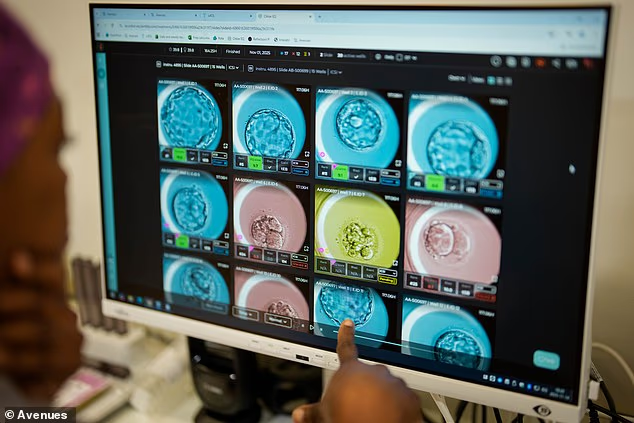
Where the AI really shines, however, is when it comes to examining the eggs, sperm, and embryos in the laboratory.
‘2.4 billion data points collected through time–lapse development are processed, detecting subtle biological patterns invisible to the human eye,’ Dr Hickman said.
According to the clinic, AI can assess eggs with at least 22 per cent greater accuracy.

If embryos are created, by just day two of development, the AI can predict with up to 96 per cent accuracy whether they’re likely to make it to the blastocyst stage
| Metric | Industry Standard | Avenues |
|---|---|---|
| Maturation Rate | 80% | 87% |
| Total Fertilisation Rate | 70% | 80% |
| IVF Failure to Fertilise Rate | 0% | |
| ICSI Normal Fertilisation Rate | ≥65% | 73% |
| IVF Normal Fertilisation Rate | ≥60% | 68% |
| ICSI Non–survival Rate | 3.7% | |
| Blastocyst Development Rate | ≥40% | 68% |
And when it comes to sperm selection, the AI can quickly identify viable sperm that traditional methods often miss.
Dr Hickman said: ‘Speed matters because the earlier sperm are identified, the greater the opportunity to preserve and prepare them safely for fertilisation.’
If embryos are created, by just day two of development, the AI can predict with up to 96 per cent accuracy whether they’re likely to make it to the blastocyst stage.
For patients, this speed is a real game–changer, according to Dr Hickman.
She said: ‘Instead of enduring days of uncertainty, patients gain earlier clarity, earlier reassurance, and more honest conversations.
‘When treatment is progressing well, we can share optimism sooner. When it is not, we can support patients earlier and more compassionately rather than allowing them to wait for devastating news at the end of the cycle.’
So, what effect is AI having in terms of success rates? The numbers speak for themselves.
Dr Hickman said: ‘Compared with standard high–performing IVF benchmarks, we are consistently observing a frozen egg survival rate of 97 per cent, an IVF fertilisation failure rate of zero per cent, an ICSI normal fertilisation rate of 83 per cent, and an IVF normal fertilisation rate of 68 per cent.

When it comes to sperm selection, the AI can quickly identify viable sperm that traditional methods often miss
‘The ICSI non–survival rate is 3.7 per cent, with a blastocyst formation rate of 71 per cent across all eggs and 66 per cent from warmed eggs only.
‘The combined efficiencies of improving every step of the clinical journey mean that patients will have 59 per cent more euploid embryos than in traditional clinics.’
However, the expert said that it’s ‘impossible to say how much of this improvement comes from our expertise or the technology.’
She added: ‘The most important shift is not purely numerical.
‘AI is changing fertility treatment from a process that can feel heavily reliant on subjective judgement and uncertainty into one that is more precise, more personalised, and more proactive.
‘For many patients, particularly those who have experienced unsuccessful cycles elsewhere, that shift in experience can be just as meaningful as the clinical outcomes themselves.’
One of the biggest impacts the technology is having for patients is on price.
In the UK, private IVF can be incredibly expensive, with a single cycle typically costing between £5,000 and £8,000.

So, what effect is AI having in terms of success rates? The numbers speak for themselves
In contrast, Avenues’ Fair IVF package is just £2,949 all–in – with ICSI and medications included.
‘The cost reduction for patients is not coming from doing less, but from doing the right things earlier, with fewer wasted steps, better decisions, and a system designed to support both patients and the people caring for them,’ said Dr Hickman.
What’s more, by designing workflows around AI support, the clinic’s staff operate on a four–day working week – with full–time pay.
‘To our knowledge, we are the only clinic in the UK offering that model at scale,’ the expert added.
One of the clinic’s proudest success stories is a couple who recently had a baby following 10 years of infertility struggles.
‘Our journey to parenthood was long, emotional, and at times incredibly difficult,’ the couple, who asked to remain anonymous, explained to the Daily Mail.
‘Over more than 10 years, we went through multiple consultations and treatments, facing repeated disappointment and uncertainty along the way.’
The couple received a diagnosis of globozoospermia – a rare, severe form of male infertility reported in just 0.1 per cent of men.

Located in London’s Euston, the clinic uses AI at almost every stage of the patient journey, from sperm selection to ultrasound analysis
They said: ‘Receiving a diagnosis made the process even more challenging, as we were often told the options were limited and the chances of success were low. There were moments where it felt overwhelming emotionally, physically, and financially, but we kept searching for answers and trying to hold on to hope.’
Eventually, the couple were referred to Avenues by a fertility doctor who recognised the clinic’s innovative approach.
To help the couple, the clinic used a combination of AI technologies – including one they call ‘ICSI SPARK’.
Dr Hickman explained: ‘AI helps us identify and select the best sperm available.
‘The egg is then exposed to a naturally occurring activating compound designed to help trigger fertilisation, followed by a modified ICSI technique that mechanically supports activation further.
‘We jump start the egg, when the sperm is unable to do so, giving the helping hand needed for a baby to be possible.’
Amazingly, this technology allowed the couple – who had previously been told that biological parenthood was impossible – to conceive using their own genetic material.
The couple added: ‘We are deeply grateful to Avenues for making what once felt impossible into a reality.’
Looking ahead, Avenues is hoping to expand its collection of AI tools even further.
It is currently exploring techniques to visualise individual organelles inside embryos, and AI that can help identify when patients may benefit from approaches such as mitochondrial donation.
Dr Hickman added: ‘Ultimately, the long–term vision is not simply more data or more technology, but a fertility journey where science, AI, and clinical care are fully integrated, giving patients not just better outcomes, but a deeper understanding of their own reproductive biology than has ever been possible before.’