Geoff Bennett:
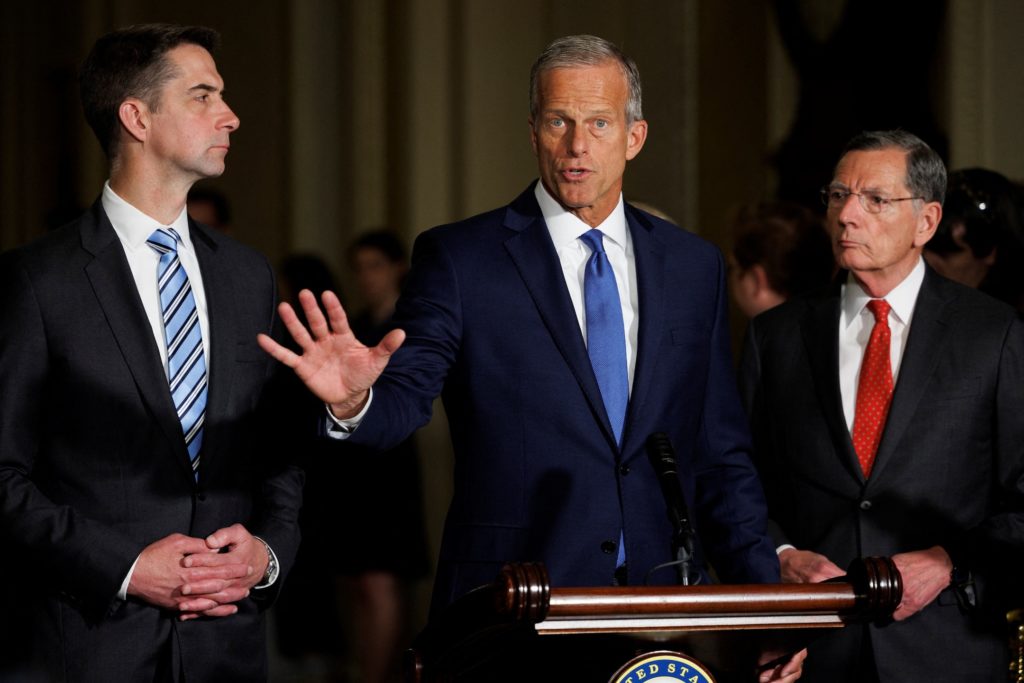
On Capitol Hill today, a dramatic series of developments unfolded as some Senate Republicans openly broke with President Trump over his request for funding tied to a new White House ballroom and a controversial so-called anti-weaponization fund.
Amna Nawaz:
Acting Attorney General Todd Blanche made an unplanned trip to Capitol Hill to personally argue the case for that fund. It didn’t work. Amidst sharp questions and concerns from Republicans, the president did not have the vote he needed and the Senate has instead left town.
Congressional correspondent Lisa Desjardins was there as all of this happened and joins us now with the latest.
Lisa, dramatic day on Capitol Hill, to say the least, leading to at least a temporary collapse of Republicans’ reconciliation bill that would fund ICE and CBP.
Lisa Desjardins:
Yes.
Amna Nawaz:
What happened?
Lisa Desjardins:
Well, per senators in the room from different parts of the Republican spectrum, Republican senators en masse pushed back at the White House today, saying, at least for now, President Trump’s request for funding have gone too far.
Now, that has derailed this key bill, at least for now. I want to look at with that bill, what’s at stake here. That’s the Secure America Act. It’s large, as you can see, and it’s almost entirely funding for ICE and Customs and Border Protection. That was poised for passage until the White House and Senator Lindsey Graham added that $1 billion, you see that there, that small slice of this bill, for the ballroom and for security.
That is what started to unravel this, but it wasn’t the only problem. After that, the president and Justice Department announced that $1.8 billion settlement with Trump to establish a so-called weaponization fund to compensate those thought to be politically prosecuted.
That created both political and ideological havoc widely across the Senate Republican spectrum. So, Senator Thune, the leader of the Republicans in the Senate, called up the acting attorney general today to explain how this fund would work, to try and reassure senators.
He gave them a one-page basically bullet point document over how it would work, trying to reassure them. The opposite happened. After about a 2.5-hour meeting, a very tense one, Republican senators instead decided they would go home and pass nothing, because they were not reassured about that fund at all.
Amna Nawaz:
That one-page document, you obtained a copy of it. What does it tell us?
Lisa Desjardins:
It is telling in both what it says and what it doesn’t.
I want viewers to look at this closely. First of all, it lays out that the president and specifically his sons are to get no monetary payment from the settlement or the fund, just an apology. Now, it does not specifically say that’s legally binding. This is all the detail that we have.
Also, how would the billions be distributed? By five people appointed by the attorney general, who, of course, is appointed by President Trump. What about the size of the settlement? That $1.77 billion, it says, is a fair amount because — quote — “Literally tens of millions of Americans are subject to unlawful targeting,” a huge amount.
Now, this document does not say anything about limiting people who were found guilty of, say, assaulting police officers or other crimes on January 6. That also was a problem for Republican senators.
Amna Nawaz:
OK, so that concern over January 6 rioters, in particular, potentially getting compensation from the fund, it’s part of this debate.
I know there was a big moment that got a lot of attention on the floor today related to that. Tell us about that.
Lisa Desjardins:
We paid attention to it. We spotted this. This was Senator Tuberville of Alabama. He just won the primary to be governor of that state for Republicans.
He took to the floor saying that many January 6 defendants should be compensated, and he returned to statements that we know are false.
Sen. Tommy Tuberville (R-AL):
Let’s be clear of what happened that day. Let’s go back and look at it. Democrats in the deep state, they hated Donald Trump so much that they orchestrated a coup against our government.
Lisa Desjardins:
Now, this, we know, is false. You and I were both there on January 6. Those rioters and those who assaulted violently the Capitol and police officers were doing so in the name of President Trump.
I raise this because it is five years later, and this is still coming up from a U.S. senator.
Amna Nawaz:
So important to make clear.
Meanwhile we know President Trump is also continuing to face pushback from lawmakers on the war in Iran. What’s the latest on that?
Lisa Desjardins:
Right. We’ve seen action this week.
The U.S. Senate now shifted so that a majority of the Senate this week voted to open the debate about Iran war powers. And, tonight, Amna, the U.S. House as we speak was supposed to be voting on that same idea, should the president be able to continue in Iran?
Let’s look at what’s happening on the House floor right now. Here’s an example of the problems for the president. Right now, they actually have skipped that vote, something called pulling the bill. That means they think they would lose that vote, which would have been a strong rebuke for the president.
Even pulling that vote alone shows opposition to the president on Iran is not just growing, but it may in fact be a majority of Congress.
Amna Nawaz:
Busy day on Capitol Hill.
Lisa Desjardins, thank you.
Lisa Desjardins:
You’re welcome.