Local businessman accuses contractor of misusing funds and failing to pay subcontractors. Contractor denies wrongdoing and says it is still owed money.
HOUSTON — A Houston-area restaurant owner says his dream of opening a new location before the 2026 FIFA World Cup has turned into a legal battle that could take years to resolve.
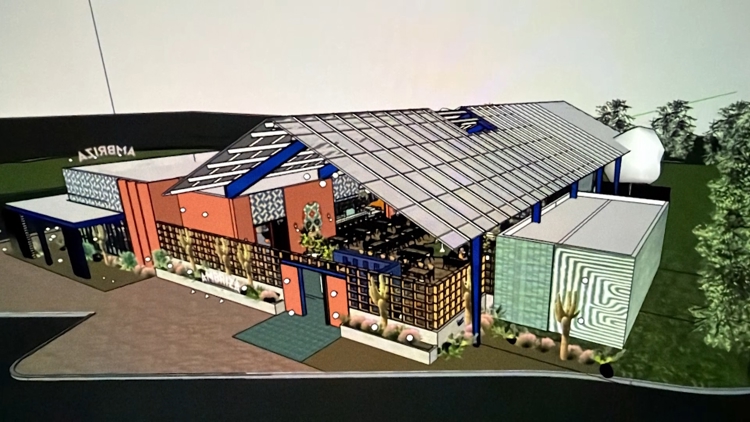
Julio Garcia, owner of Ambriza, says his company’s planned first standalone restaurant in Webster was supposed to be its biggest expansion yet and timed to open before the global event expected to bring hundreds of thousands of visitors to the Houston area.
Garcia says the project is now at a standstill.
“If you go there today, there’s nothing, there’s dirt,” Garcia told KHOU 11.
Garcia hired Blue Kite Building Group to coordinate construction on the project. Contract documents reviewed by KHOU 11 show “substantial completion” was expected no later than 304 calendar days from the start of work.
Garcia says problems started when suppliers began reaching out about unpaid bills.
“We started noticing our suppliers were not getting paid,” Garcia said.
Liens filed as payment questions grew
Court records show multiple liens were later filed against Garcia’s property, with companies claiming they were still waiting to be paid by Blue Kite.
Financial statements reviewed by KHOU 11 also show money was still being withdrawn for the project during that time.
“When you have vendors calling you, where’s my money,” Garcia said. “You’re in default the moment you have a lien against your property.”
Garcia says he confronted Blue Kite leadership, demanding answers.
“They didn’t have an answer why suppliers weren’t getting paid… why the project was not moving forward,” he said.
Contract terminated, lawsuit filed
Records show Garcia eventually terminated the construction contract.
Blue Kite later filed its own lien against the property, claiming it was still owed more than $258,000 for work completed.
Garcia’s company, Flyway Land Holding, then sued Blue Kite in Harris County court.
In the lawsuit, Flyway is seeking more than $1 million in damages, alleging Blue Kite misused construction funds, failed to pay subcontractors and suppliers, and committed fraud.
Blue Kite denies those allegations.
KHOU 11 found other lawsuits involving Blue Kite
KHOU 11 also reviewed two other active lawsuits involving Blue Kite entities that include similar issues and payment disputes.
Garcia says learning about those cases only added to his frustration.
“It didn’t only happen to me, it happened to others,” Garcia said. “We discovered there are others, other groups that have filed lawsuits against them for what seems like exactly the same claim.”
Blue Kite denies wrongdoing
KHOU 11 reached out to Blue Kite’s owner and CEO by phone, text and email multiple times requesting an interview but did not receive a response.
Blue Kite’s attorney Tres Gibbs denied wrongdoing in a detailed, written statement:
“Thank you for allowing Blue Kite the opportunity to respond. Blue Kite is a general contractor that specializes in commercial projects ranging in size from those smaller to those much larger than the Flyway Ambriza project. This was a $4,000,0000 industry standard cost-plus contract. Blue Kite completed about 30% of its scope, including all the underground utilities, electrical, paving, building pad, and commenced foundation work, and billed Flyway for nearly the same amount, about $1.2 million. So, the notion that Blue Kite has diverted or misappropriated project funds is ludicrous and appears to be a fabricated pressure tactic for litigation and settlement purposes.
To be clear, the vast majority of Blue Kite’s subcontractors and suppliers have been paid. Contrary to Flyway’s allegations, the only subcontractors who have not been paid are those that are owed money along with Blue Kite on Blue Kite’s last two pay applications. Even though the work in those applications was completed prior to termination, Flyway refused to pay after it terminated Blue Kite. Blue Kite has strong relationships with its subcontractors and suppliers, who all understand they will be paid once and as soon as Blue Kite is paid by Flyway. It is ironic that Flyway blames Blue Kite for filing the lien and interrupting the project’s financing, considering Blue Kite only filed the lien in the first place to protect itself after Flyway refused to pay as required by the contract.
Mechanics and materialmens lien rights are among the most powerful legal tools that laborers have to secure their right to payment, which the Texas legislature recognizes is essential to protect contractors. Blue Kite has invoices and time sheets to support all the costs it submitted, which have all been approved by Flyway’s lender. Thus, Blue Kite would welcome the opportunity to prove the falseness of Flyway’s claims. Unfortunately, the owner’s decision to take the risk of mobilizing Blue Kite to the site before the architectural plans were ever completed, approved, or permitted by the City of Webster resulted in delays and extra costs from the start. But Flyway cannot blame that decision on Blue Kite, which warned Flyway about the risks of such approach.
Despite the salacious claims in its pleadings, ultimately Flyway acknowledges that it owes Blue Kite money. Although it seems determined to attack technical aspects of Blue Kite’s lien in an effort to avoid paying Blue Kite (and ultimately, Blue Kite’s subs), the Court has already denied Flyway’s motion to remove Blue Kite’s lien. Flyway’s resources would be better served by resolving the payment dispute than by waging a costly legal battle.
Project remains stalled
For now, Garcia’s Webster project remains on hold.
A judge has kept Blue Kite’s lien in place and the next court date is scheduled for May 25.
Garcia says there are no guarantees the restaurant will ever open.
“What you did affected me and my family,” Garcia said. “What you did impacted my business tremendously.”
While Ambriza continues serving customers at its existing locations, Garcia says the future of the Webster expansion remains uncertain.