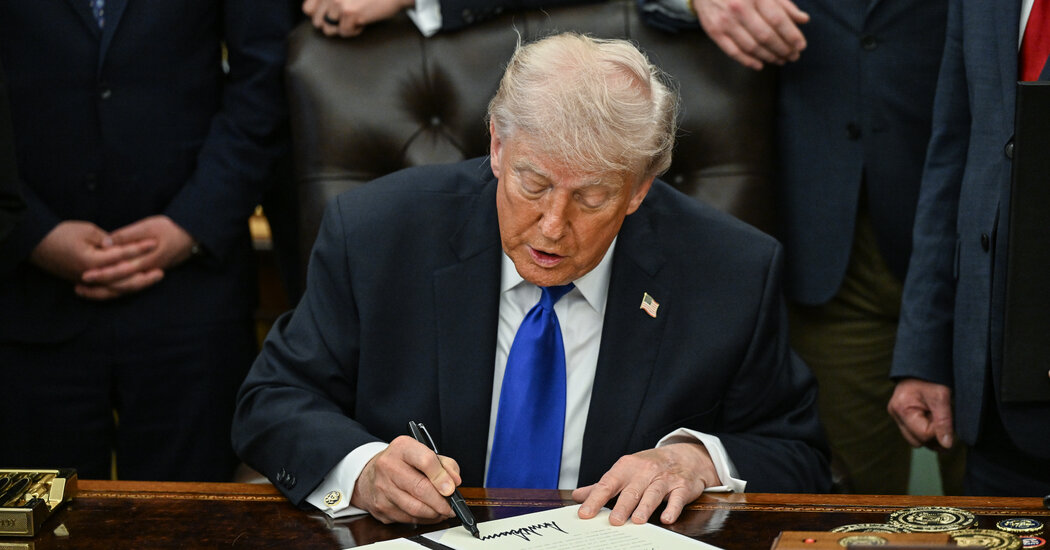
President Trump plans to sign an executive order on Thursday giving the government the power to evaluate artificial intelligence models before they are publicly released, people working on the order said. It marks a shift for an administration that promoted a hands-off approach to the powerful technology.
The order will give the Office of the National Cyber Director, which sits within the White House and oversees cybersecurity coordination in the government, and other agencies two months to develop a process for evaluating the models, the people said. The goal is for the government to identify any security vulnerabilities revealed by A.I. models and to patch problems in its systems to help protect banks, utilities and other sensitive industries from cyberattacks.
The White House has proposed that the major A.I. companies voluntarily share their models from 14 to 90 days before a public release, the people said. The final process could also include the creation of a vault for security vulnerabilities, for companies and cybersecurity researchers to report vulnerabilities they find using A.I. models, some of these people said.
Mr. Trump’s executive order would formally shift the White House from its anything-goes approach with A.I. companies, which the president has said could help advance the United States in a technological race against China. Now, the administration plans to take a more hands-on stance. The decision to begin a formal oversight process stemmed from fears that A.I. was becoming too powerful and could pose a security risk to the United States in the future, officials familiar with the discussions said.
Those fears increased last month after the start-up Anthropic announced a new A.I. model, Mythos. Anthropic said the model could find software vulnerabilities and lead to a cybersecurity “reckoning.” Government officials, banks and others worried that future A.I. models could find vulnerabilities that U.S. enemies would exploit.
Those concerns pit U.S. officials who favored some A.I. regulation for national security reasons against those who preferred a hands-off approach toward America’s corporate interests, including A.I. companies. Until the release of Mythos, the Trump White House had largely ignored cybersecurity as a top policy priority.
“Not fully understanding the importance of cyber until something massive happens is pretty common,” said Cynthia Kaiser, a former top cybersecurity official at the F.B.I. and an executive at the digital security firm Halcyon. “Mythos raised concerns within the government, much the same as when a C.E.O. finds out their own networks have suffered a massive breach.”
The White House didn’t immediately respond to requests for comment. Anthropic, OpenAI, Google, and Microsoft also did not immediately have any comment.
Negotiations over the executive order began the first week of May, with White House officials meeting with A.I. executives. Officials hoped that Mr. Trump would be able to sign the executive order before May 14, when he and China’s leader, Xi Jinping, met for a summit in Beijing. The United States and China have been locked in an A.I. arms race over everything from language models and chips to A.I.-backed weapons.
Within the Trump administration, some argued that China’s control of domestic A.I. gave Beijing an edge by allowing it to steer and access new A.I. models, two officials familiar with the discussions said. They suggested that the Trump administration could set up a regulatory body to review A.I. models before they were publicly released.
But officials ultimately decided that a review board would create too much bureaucracy and slow down A.I. companies.
The U.S. government previously relied on tech companies voluntarily sharing information about their models. Not every A.I. company participated and the organization responsible for research, the Center for A.I. Standards and Innovation, published few reports on the A.I. models released over the past year.
But the White House faced pressure from banks and tech companies to do more after Mythos was released. And public concerns about A.I. have mounted. In a recent Quinnipiac University poll of American adults, 55 percent said they saw A.I. as a force for harm rather than good, driven by worries about job losses and mental health as well as rising energy prices as data centers use more power.
On Fox Business on May 6, Kevin Hassett, the director of the White House National Economic Council, became one of the first administration officials to speak publicly about an A.I. review process, saying the administration was considering evaluating models “so that, you know, they’re released in the wild after they’ve been proven safe, just like an F.D.A. drug.”
His comments initially caused alarm in the tech industry, which had embraced the government’s hands-off approach.
That night, Susie Wiles, the White House chief of staff, published her fourth social media post on X, saying that the White House would “lead an America first effort that empowers America’s great innovators, not bureaucracy, to drive safe deployment of powerful technologies while keeping America safe.”
The post bought the administration time as it held discussions with the major A.I. companies on an executive order. A model review process recalled some of the approaches once advanced by the Biden administration in 2024.
Mr. Trump’s summit in China briefly paused the negotiations. When U.S. officials returned, they spoke with executives from Anthropic, OpenAI, Google and others to work out the wording of an executive order.
White House officials have invited those executives to attend the signing of the executive order in the Oval Office on Thursday.
Dustin Volz contributed reporting.