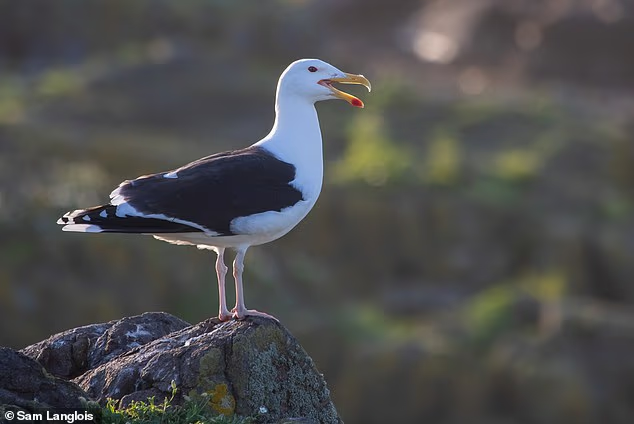
They might divide opinion with their loud screeches and tendency to steal your chips – but British seagulls are struggling to survive, experts have warned.
New research reveals their numbers are in steep decline in Britain, painting a bleak picture for the seaside scavengers.
Those affected include the Black–headed Gull, the Common Gull, the Lesser Black–backed Gull and the Great Black–Backed Gull.
Over the last two decades, the total number of gulls spending the winter in Britain has decreased from 3.9 million to just under 2.5 million.
This decline is largely driven by the spread of disease, changes in land use and global warming.
The warning follows new data released by the British Trust for Ornithology (BTO), which detailed its findings in a report called the Winter Gull Survey (WinGS).
Emma Caulfield, BTO Research Ecologist and survey coordinator said: ‘These figures are pretty alarming, and suggest that these enigmatic gulls are having a tough time across the UK.
‘Despite these smart and adaptable birds figuring out how to live alongside us, the ever–changing world appears to be moving too fast for them to keep up.’
The UK’s largest gull, the seemingly formidable Great Black–backed Gull, has seen a drop of up to 66 per cent during the winter months

New research reveals gull numbers are in steep decline in Britain, painting a bleak picture for the seaside scavengers

The BTO’s report also found that Common Gull numbers fell by 26 per cent over the last two decades
Figures from WinGS show that Black–headed Gulls declined by almost half in the last 20 years.
In the short term, this drop is likely reflective of breeding colonies being heavily impacted by a disease called High Pathogenicity Avian Influenza (HPAI) in the summer of 2023.
Common Gull numbers fell by 26 per cent and Lesser Black–backed Gulls suffered a 47 per cent decline during the same period.
The UK’s largest gull, the seemingly formidable Great Black–backed Gull, also saw a drop of up to 66 per cent during the winter months.
‘Reasons for the broad declines are unclear, and they may be caused by multiple factors with one or more drivers affecting different species and different populations,’ the report reads.
‘These may include changes to breeding habitat, human disturbance, increased predation at breeding colonies, changes to fisheries policies and the effects of disease.
‘The results from the survey confirm the changes in gull populations observed by other monitoring schemes and suggest broad declines are occurring across the breeding ranges of most of the gull populations wintering in the UK.’
It added that despite the declines, gulls continue to ’cause controversy and invite strong and often negative opinions due to their interactions with humans within the urban environment.’

Pictured: Seagulls attacking a couple trying to enjoy their fish and chips on the esplanade at Lyme Regis

A wacky study recently claimed that the best way to prevent the birds from stealing your chips is by sticking googly eyes on your takeaway box
Seagulls are essential to the UK’s coastal and urban ecosystems.
They act as natural waste managers, scavenging on dead animals and organic matter which helps reduce the spread of disease and keep shorelines clean.
‘By understanding the problems these familiar and widespread birds are facing, we can hope to reverse some of the negative trends and work to ensure that they remain a part of our cherished seaside environment,’ Ms Caulfield added.
A wacky study recently claimed that the best way to prevent the birds from stealing your chips is by sticking googly eyes on your takeaway box.
Researchers from the University of Exeter found that the gulls were put off by the eyes and were slower to approach and less likely to peck at the boxes.
‘Many animals – both wild and domesticated – are very aware of eyes, which can indicate the presence of a predator or be used to communicate intent,’ explained lead author, Dr Laura Kelley, in an article for The Conversation.
‘Direct eye contact often conveys aggression, while looking away indicates a lack of threat.
‘Animals generally respond defensively when they see eyes staring at them.’
Experts have also previously suggested wearing highly–contrasting patterns, such as zebra stripes or leopard print, to deter seagulls.
Meanwhile eating underneath a parasol, umbrella, roof, narrowly–spaced bunting or even with your back against a wall can help.
Other tips include never leaving a bag unzipped, as seagulls will ‘rifle through your bags if unattended’. The animals are ‘very familiar’ with grocery bags, crisp packets and pasty bags.
And, finally, never feeding gulls can help prevent them carrying out the behaviour in future.