For many Brits, the day doesn’t really start until that first cup of tea.
But a new study might make you think twice before popping the kettle on this morning.
Scientists from the University of Queensland have issued an urgent warning about the microplastics released from plastic kettles.
Their research revealed that the first boil in a new kettle can release around 12 million nanoparticles per millilitre.
That equates to almost three billion particles in an average 250ml cup of tea.
‘Boiling water in plastic kettles is a daily routine for millions of people worldwide and we have found this simple habit can release tiny plastic particles into the water we use every day,’ said Dr Elvis Okoffo, lead author of the study.
‘This study provides evidence that plastic kettles can be a source of daily human exposure to nanoplastics and microplastics and that new plastic kettles release notable concentrations of these particles into water during boiling.’
Worryingly, the long–term effects of these microplastics on human health remain unclear.
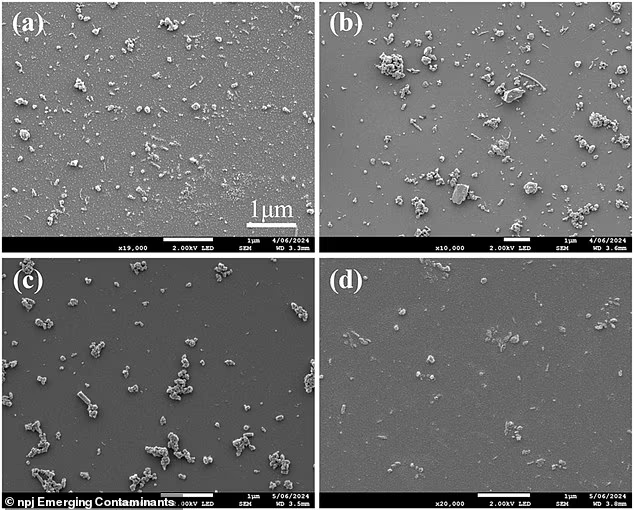
The first boil in a new kettle (a) can release around 12 million nanoparticles per millilitre. After 150 boils (d), there are still 820,000 nanoparticles detected per millilitre, which equates to 205 million particles per 250ml cup of tea

For many Brits, the day doesn’t really start until that first cup of tea. But a new study might make you think twice before popping the kettle on this morning (stock image)
Previous studies have warned about the microplastics released from tea bags.
However, until now, the number of particles coming from the kettle itself has remained unclear.
To get to the bottom of it, the researchers analysed the nano and microplastic particles leached into the water after 150 kettle boils.
While the particles released after the first boil were the most intense, levels remained fairly high throughout the experiment.
After 150 boils, there were still 820,000 nanoparticles detected per millilitre, which equates to 205 million particles per 250ml cup of tea.
If you live in an area with hard water, there’s good news.
The researchers also found that hard tap water significantly reduced the amount of particles released.
The researchers suspect this is likely due to minerals forming a protective coating inside the kettle.

The researchers analysed the nano and microplastic particles leached into the water after 150 kettle boils
Based on the findings, the researchers are urging tea lovers to be particularly careful when making drinks with a new kettle.
‘Simple rinsing before first use is common, but it does not achieve the same level of removal as repeated cycles of boiling and discarding,’ Dr Okoffo said.
‘Many people may overlook or skip this step, highlighting the need for clearer product labelling and instructions.
‘I would call on manufacturers, policymakers and regulators to inform consumers with safety guidelines or product labels warning about plastic particle release.
‘Although particle concentrations drop with repeated use, our research shows there is a continuous, low-level exposure risk.’
Despite their prevalence, scientists still don’t know the long-term effects of microplastics on human health.
Researchers are increasingly concerned about the capacity of such particles to be internalised within cells causing alterations in cellular function, particularly when interacting with organs in children and causing definitive alterations in adult life.
There is a growing body of evidence that plastics could play a key role in early-onset cancer genesis, where healthy cells turn cancerous.
In 2024, a study found cancer cells in the gut spread at an accelerated rate after contact with microplastics.
Experts have also raised the alarm about a potential link between microplastics and reproductive health.
Dr Okoffo added: ‘The concentrations of these particles and the extent of human exposure remain poorly understood.
‘The study fills an important knowledge gap about how plastic products used in homes can contribute to daily plastic exposure and how small, practical changes in everyday routines can reduce exposure to plastics.
‘By combining better product design, improved labelling, and public awareness, we can help limit the amount of plastic entering both our bodies and the environment.’