Amna Nawaz:
President Trump’s visit to China is a reminder of the long, intertwined history between the two countries. Asian Americans are the fastest growing demographic group in the United States, yet across 250 years of American history, their stories and the discrimination they faced have often been overlooked.
Tonight, Judy Woodruff looks at how that past continues to shape the question of who belongs in America. It’s part of her series America at a Crossroads.
Judy Woodruff:
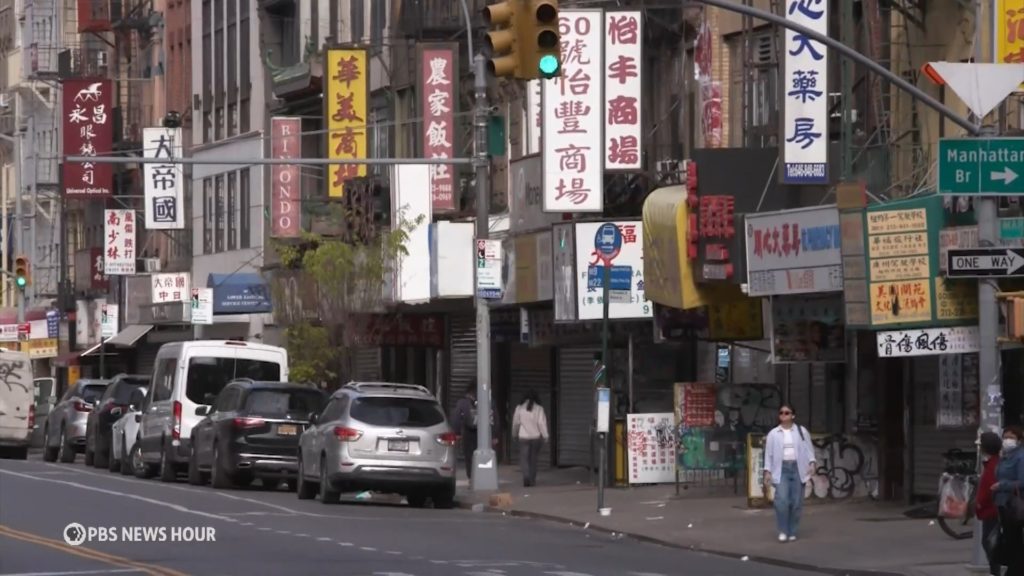
In the early morning light, Manhattan’s Chinatown is already in motion. Vendors unpack for the day. Children head to school, and in Seward Park, tai chi warm-ups slow and steady.
But this neighborhood also holds a darker story of arrival, exclusion and resistance.
Michael Luo:
This is kind of where Chinatown in New York City really got its start.
Judy Woodruff:
I met up with journalist and author Michael Luo, whose latest book, “Strangers in the Land,” traces that history across the United States, beginning in California.
Michael Luo:
As the hostility towards the Chinese got worse and worse on the West Coast, they started to come East, and they ended up here on Mott Street.
And the story of Chinatown in the United States is a story of exclusion, because these were essentially ethnic ghettos where people were just kind of clustered together in the Chinese Quarter.
Judy Woodruff:
To stay safe.
Michael Luo:
Yes.
Judy Woodruff:
But for Luo, the son of Taiwanese immigrants and now an executive editor at “The New Yorker,” the story began far from Chinatown with a confrontation with a stranger on Manhattan’s Upper East Side in 2016.
Michael Luo:
She turned and said, “Go back to China.” And so I, with the adrenaline flowing, trying to think of something smart to say in response, I yell: “I was born in this country.” And it just felt so pathetic.
Judy Woodruff:
Luo sees his own personal experience growing out of a much deeper pattern in the country, one that was tested time and time again.
Michael Luo:
It is that question that we have been wrestling with for much of the history of the American republic of who gets to be an American.
Judy Woodruff:
We sat down inside Cooper Union’s Great Hall, a stage for American debate for more than a century.
At one point, I think you said the precarity of the Asian American experience.
Michael Luo:
Precarity, I think, is a good word, because it might be easy for some Asian Americans to feel like, oh, we are in these rooms and we are successful and that kind of thing. But if there’s some sort of shock to the system, like COVID, like an economic downturn, that precarity is revealed. And we have seen throughout American history the way that happens.
Extraordinary place that preserves this history.
Judy Woodruff:
Luo took us to the Museum of Chinese in America, which highlights that history, including the massive influx of Chinese laborers during the gold rush.
After that faded, many went on to help build the transcontinental railroad, segregated from white workers and paid far less.
Michael Luo:
This is a famous photo because there are no Chinese in it.
Judy Woodruff:
Even though they played an enormous role.
Michael Luo:
Yes.
Judy Woodruff:
That gap between contribution and belonging kept widening, and by the 1870s economic fear and political division were growing.
Michael Luo:
That is when you start to see just legions of unemployed, underemployed white working men, as they called them. And also I think the country was really politically polarized. It sounds familiar.
Judy Woodruff:
Yes.
Michael Luo:
All this all sounds very familiar. Both the Republicans and Democrats — and, remember, the Republicans were the party of Lincoln, freed the slaves, stood for equality and all these great ideals. They became just as ugly and vociferous in their rhetoric about the Chinese as the Democrats.
And the reason is because they were trying to win the votes on the West Coast, and so they needed California, Washington, Oregon, these young states that had a heavy influence of Chinese arrivals, and there was a growing hostility there.
Judy Woodruff:
That backlash led to the Chinese Exclusion Act of 1882, the first U.S. law to bar entry to the United States based explicitly on race and nationality.
Michael Luo:
Nearly 200 communities in the American West expelled the Chinese from their communities, in many cases violently. And historians call this period the Driving Out.
But the Chinese were still coming in, and communities were upset, and they took matters into their own hands.
Judy Woodruff:
In 1871, a mass lynching in Los Angeles killed at least 17 Chinese immigrants, 14 years later, another attack in Rock Springs, Wyoming. Anti-Chinese policies intensified. The 1892 Geary Act forced Chinese residents to register and carry papers or face deportation.
On the West Coast, many were detained at Angel Island.
Michael Luo:
This is a photograph of an interrogation. And so you would come in, get off the boat, you would be sent to Angel Island and they’d be interrogating you about your story, and so…
Judy Woodruff:
He looks young. It’s a young man.
Michael Luo:
Yes. Yes. It’s a boy.
Judy Woodruff:
Maybe even a teenager.
Michael Luo:
Yes.
Judy Woodruff:
During his research, Luo found a notebook from a sheriff.
Michael Luo:
It’s almost like mug shots.
Judy Woodruff:
Tracking Chinese residents.
Michael Luo:
It’s like a record of surveillance, which is really haunting.
Judy Woodruff:
It’s creepy.
Michael Luo:
And so some of these things, like, “Gone to China for good, 1900, went to China,” and then you start to see this one. You see this one. It says “dead.”
But when you look into their faces, like, you’re just kind of curious who they are, what their stories are.
Judy Woodruff:
As restrictions grew, so did the resistance, like here at Cooper Union, where Chinese activists gathered in 1892 to protest, led by Wong Chin Foo.
Michael Luo:
It’s kind of extraordinary.
Judy Woodruff:
We found a signature from the civil rights organization he co-founded hidden deep within the archives.
Michael Luo:
You come down to September 22, and it says Chinese Equal Rights League.
Judy Woodruff:
Other Chinese community leaders ordered people to refuse registration. It was also during this period that the nationality of San Francisco-born Wong Kim Ark was challenged.
Man:
Everybody in this country gets due process and equal protection.
Judy Woodruff:
Leading to the landmark Supreme Court ruling on birthright citizenship that is again being tested in the courts today.
For Luo, all this history reveals a consistent thread.
Michael Luo:
Difference is hard, I think, in our personal lives, I think in our companies, in our churches, in our schools, and so I think just human nature. I think this is why this kind of experiment that was happening in California, this multiracial experiment, really was a test for us as a country. And we didn’t do particularly well in it.
Narrator:
In San Francisco…
Judy Woodruff:
The exclusion era lasted 83 years. Restrictions eased slightly during World War II, but full immigration equality didn’t come until 1965, when President Lyndon Johnson signed the Immigration and Nationality Act here in New York at the feet of the Statue of Liberty.
That change helped drive a new wave of migration, including Luo’s own parents. Today, the United States is home to the largest Chinese diaspora outside of Asia.
Michael Luo:
This is not just the story of the Chinese in America. It’s the story of any number of immigrant groups who have been treated as strangers.
Judy Woodruff:
Is the United States held to a higher standard than other countries?
Michael Luo:
I think we should be, perhaps, when you look at our founding documents that we hold these truths to be self-evident that all men are created equal. I mean, America has always been a place driven by that, the idea of America.
We have stood for these ideals, and so maybe we should be judged by a higher standard.
Judy Woodruff:
For the “PBS News Hour,” I’m Judy Woodruff in New York City.