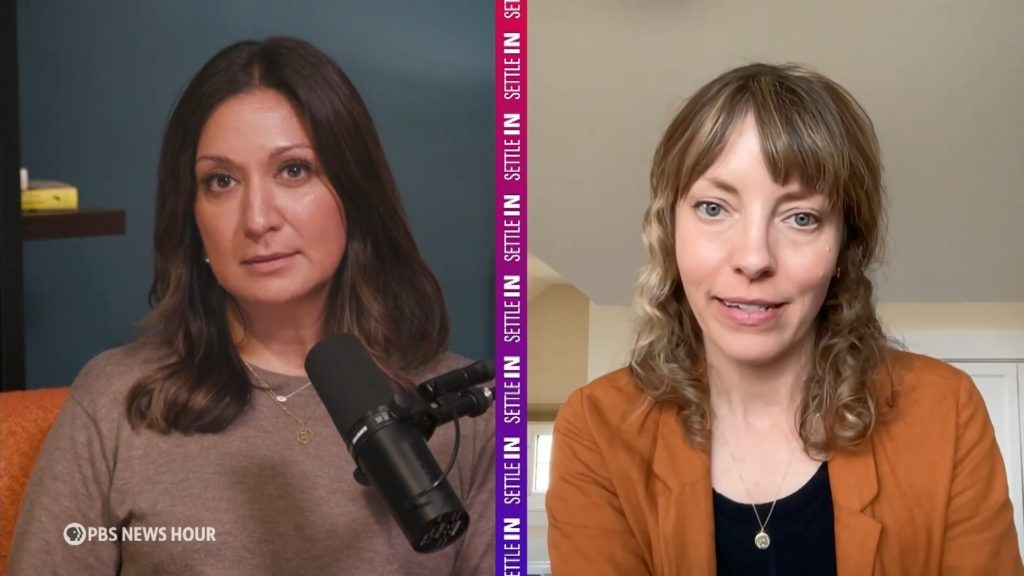
How did American kids become such picky eaters? On our Settle In podcast, Amna Nawaz asked that question to author and historian Helen Zoe Veit. Her latest book is “Picky: How American Children Became the Fussiest Eaters in History.”
Amna Nawaz:
So, how did American kids become such finicky eaters?
Our “Settle In” podcast asked that question to author and historian Helen Zoe Veit, whose latest book is “Picky: How American Children Became the Fussiest Eaters in History.”
Here now is an excerpt of that conversation.
You go back to the 1800s, you say kids back then were eating like little omnivores, meaning they ate everything, rabbit and codfish cakes, deer liver, vinegary pickles. Why were they doing that? What was it about the time and the food that had them eating that way?
Helen Zoe Veit, Author:
Yes, I came to see the 19th century as this crucially important time.
It’s really the last moment in America where, like, childhood pickiness didn’t even exist as a concept. They were playing outside more. They were doing physical chores. Most Americans lived on farms at the time, so farm children were just involved in the work of the home.
They often walked to school, and at the same time they weren’t snacking much. So, they weren’t — there just wasn’t much edible food between meals. So, children would typically come to meals hungry, sometimes really hungry. They hadn’t eaten since lunch a lot of the time.
Another thing that changed in the 20th century too was milk drinking. So, starting in the early 1900s, nutritionists started saying, milk is the essential food of childhood. Kids have to have milk to grow. And, by the way, they hadn’t actually been drinking that much milk in the 19th century, because, unless you lived on a dairy farm, there wasn’t refrigeration. It was hard to get fresh, unspoiled, uncontaminated milk.
So, milk drinking hadn’t been that common in the 19th century, but it explodes in the 20th century. The recommendation is that kids as young as 2 years old drink a quart of milk — that’s four cups of creamy whole milk — a day, and it really tamped down appetites for meals.
So, kids would come to meals, they weren’t exercising as much, they were snacking more, they were drinking large amounts of milk, and it really affected their ability to learn to like new foods.
Amna Nawaz:
There’s so much fantastic, useful advice in the book as well that’s based in history and in science. So, this whole idea of sitting a kid down at mealtime and saying, you got to clean your plate, you got to finish the food in front of you, should that be a goal? Is that something parents should do?
Helen Zoe Veit:
I — well, I will just speak for myself. I never said you have got to clean your plate. But the idea that you should never tell a child to eat or that children should always decide the quantity, that’s not a long historical idea.
I think parents often have a better idea than children of what an appropriate amount is. And if a child has eaten very little at a meal, I think it can be appropriate to ask them to have one or two more bites or three, depending on their age and what you see, especially if you’re the parent and you know they say they’re full and then 15 minutes later they ask for a snack.
If you have that experience and you know your child, I do not think it is necessarily traumatic or bad to say like, hey, you haven’t had dinner yet. You need to have two more bites and then we will call that dinner.
Amna Nawaz:
OK, if a kid doesn’t want what’s on offer at the table, should you offer them something else?
Helen Zoe Veit:
I am more radical than most people today on this. There are many pediatricians who say, no, but you can offer them fruit. I stuck with the historical method, 300,000 years of human history.
And I didn’t offer them any alternatives. But, again, my children never once went actually went hungry. I would always offer them the same food warmed up if they got hungry later. It always worked with my kids.
Amna Nawaz:
OK, is it ever OK to offer a reward for trying a new food or eating less popular food, like, hey, if you finish your spinach, you can have a cookie. Is that OK?
Helen Zoe Veit:
Psychologists in the 1940s and 50s said, no, don’t ever reward your kid. They will associate desserts with love and rewards. That — they just made that up. There was literally no evidence. There were no comparative studies.
Europeans and Americans have been having desserts after dinner for centuries with good outcomes. So to say you can’t have dessert until you finish your dinner, or if you finish your dinner, if you have two more bites, whatever you as a parent decide, you can have a snack afterwards, or you can have a gold star or a sticker, I think those are incredibly great tools for helping kids learn to like new foods.
And there’s literally no evidence that they’re harmful.
Amna Nawaz:
And you can check out that full episode of “Settle In” on our YouTube channel or wherever you get your podcasts.
Geoff Bennett:
I will be watching that.
(Laughter)