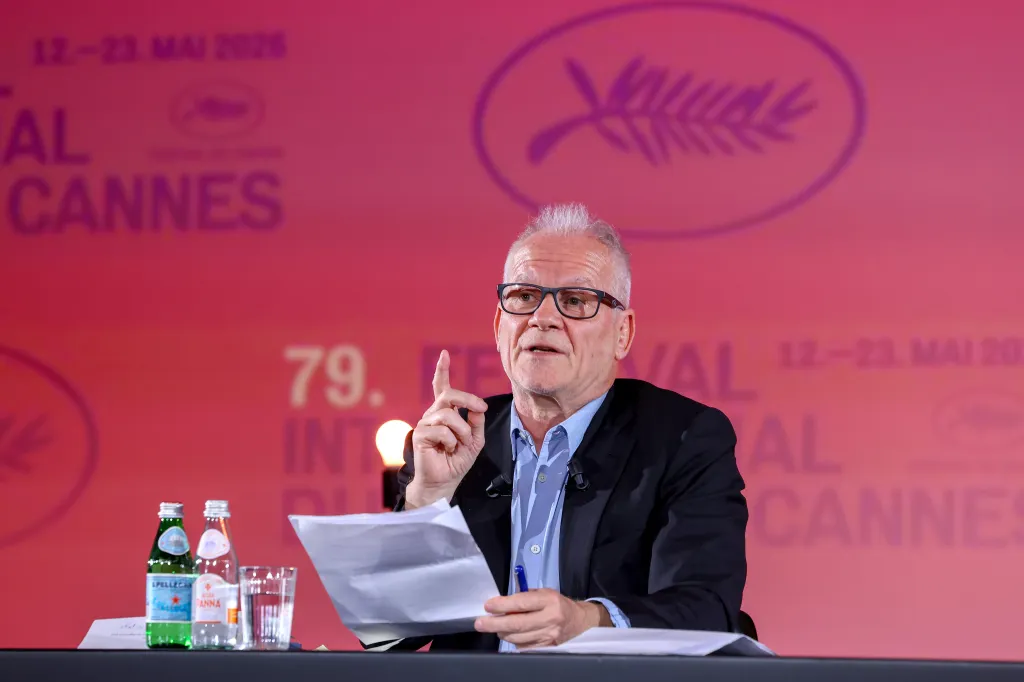
Cannes Film Festival Director Thierry Frémaux took to the stage on Monday for his traditional meeting with the press on the eve of the opening ceremony.
In a sign of the complexity of the times, he was grilled on everything from AI to new Oscar submission rules; selfies; the festival’s gender parity record; steps taken to Berlinale backlash, the Hollywood studios and Fast and Furious.
On whether the festival had taken steps to prepare its jury and the film teams on how to deal with thorny political questions in the light of the Berlinale’s rocky ride, Frémaux did not give a direct answer.
“The question raised in Berlin is one that regularly comes up at the festival, which for a long time was considered as a very political festival. Is it more or less than before? We’re living in different times, it’s hard to make a comparison,” he said.
Frémaux waded in to defend Wenders who found himself at the heart of the Berlinale backlash after he declared at the opening jury conference that filmmakers should “stay out of politics”.
“I would like to pay tribute to Wim Wenders because I think he was subjected to criticisms that weren’t really justified. I understood what he wanted to say, but I think people didn’t want to understand what he was saying,” he said.
“He wanted to say that the politics should be on the screen. That’s what we say at Cannes… the festival considers that political questions are primarily those of the artists’ voices and the voices of the artists whose work is being shown.”
He said that while filmmakers in Official Selection were free to express or not express their political views if questioned, it was not his job or that of the jury or management to wade in on politics.
“We’re in a world partly at war, a world in a fragile state in terms of dialogue between nations. We don’t want to add to the confusion with our analysis of what’s going on… I often say, and I deeply believe this, that art, and cinema in particular, are instruments of peace, even when they are calling for rebellion and freedom.”
Gender Parity
Frémaux came with notes for a question on the festival’s track-record over gender parity, which he said he had been expecting.
The fact that only five of the 22 films in the running for the Palme d’Or this year are directed by women, against seven in 2025, has sparked criticism from French gender-parity group Le Collectif 50/50 in the lead-up to the festival.
The group, which was created in the wake of the MeToo movement, has accused the festival of “feminism washing” in relation to its official poster featuring Geena Davis and Susan Sarandon in 1991 road movie Thelma & Louise.
A journalist from the AFP asked why in Cannes only 23% of the main prize contenders were women, while the Berlinale managed to approach parity this year, with nine of the 22 Golden Bear contenders by women.
Suggesting her question had been prompted by the Le Collectif 50/50 poster comments, Frémaux responded: “At no moment would we have chosen an image of Geena Davis or Susan Sarandon or Ridley Scott’s film for the poster to make ourselves look feminist.”
He acknowledged that in the past the festival’s track record had been questionable, evoking the selection in 2012 when not a single female director made it into the main competition, but said it had striven in recent years to play its part in rectifying the situation.
He said that Cannes had been one of the first festival to sign up for Le Collectif 50/50’s equality charter in 2018 and had acted on its stipulation that juries and its government body achieve gender parity, but noted that there is no clause in the charter demanding parity in the Official Selection.
Studying his notes, Frémaux said that 28% of the films submitted this year had been by women, while female-directed films accounted for 34% of the across the entire selection and 38% in the short film competition.
“Today we’re seeing more and more women directors coming into cinema, so they’re gradually making their way into the competition,” said. “The figures show its moving forward, but also that it’s slow, that it’s not enough.”
Frémaux said the entire cinema industry had to get behind a gender parity push, pointing to the challenges for female directors to make their second feature as well as the need for more cinema made from a female point of view.
“As in literature and in music, we need the world seen from a female perspective, a woman’s sensibility, to be more present in the world of film,” he said.
The festival director promised fresh dialogue with interested parties in future but said negative campaigns on social media were not the answer.
New Oscar rules
This year’s edition of Cannes comes just days after the Academy of Motion Picture Arts and Sciences (AMPAS) unveiled a game-changing shake-up of the eligibility rules for the non-English language Best International Feature Film category, which will lend even more weight to the Palme d’Or winner.
Under the new rules, as well as being submitted by a country or region via an Academy-approved selection committee, a non-English language film can also become eligible for consideration in the category by winning the top prize at qualifying festivals Berlin, Busan, Cannes, Sundance, Toronto or Venice.
Frémaux welcomed the changes, suggesting it was sign of the rise of international films in the overall Oscar race, citing 19 nominations in the run-up to the 98th Academy Awards for films which screened in Cannes last year.
“When people say that America is turning inward, it’s not true. In any case, Hollywood is opening up to the international scene, opening up to universality; that’s what Cannes is all about, it’s about universality,” he said.
He acknowledged that the new rules would avoid a situation such as that of the 2026-26 Oscar cycle in which Jafar Panahi’s It Was Just An Accident ran as France’s candidate rather than for Iran, where his anti-government stance means he is unlikely to ever be the country’s official candidate.
Frémaux added it would also open up the possibility of a country with a strong crop of films having more than one film in the running in the category, noting the strong showing for Japan and Spain in Official Selection, with three films each.
He downplayed a question on whether the rule change might influence the jury’s decision and sway them towards awarding the Palme d’Or to dissident filmmakers who would benefit from the award, such as Iranian director Asghar Farhadi and Russian director Andrey Zvyagintsev, who are in competition with Parallel Tales and Minotaur this year.
“The jury is nine people. There is not one political conscience, there are nine personal positions… It could be there that there is someone on the jury who is extremely politicised. Paul Laverty might be very political, he writes very political films but that perhaps he not like that as a spectator,” he said, referring to the UK writer and longtime Ken Loach collaborator who is in the jury this year.
“Cineastes very often like cinema that is different from their own, and not the same as their own… even last year, I won’t reveal the jury’s secret, I never felt that the favorable opinion that ultimately emerged in favor of Jafer Panahi had the slightest the political bias.”
AI
Frémaux was also asked his opinion on AI, and what implications of the technology for the filmmaking.
“Artificial intelligence is what the electric bicycle is to the bicycle. To ride an electric bicycle, you need to know how to ride a bike,” responded Frémaux. “It’s becoming a bigger subject in cinema. We have to be on our guard, but at the same time understand it a bit,” he said.
“The real question is what does it mean for our lives, our existence, our children,” he said. “What are the rules. The Oscars decided recently that an AI character cannot run for the best actor prize. That makes perfect sense.”
He likened the current debate around AI to that around the arrival of digital technology and special effects, and move away from celluloid and chemicals, evoking questions around whether films with digitally manipulated images are less authentic that those in the works of F. W. Murnau Murnau, Erich von Stroheim and the Lumière brothers.
Frémaux suggested that films made without AI or special effects were a bit like organic wine.
He suggested that the last “organic film” was Francis Ford Coppola’s Apocalypse Now, citing the Flight of the Valkyries helicopter attack scene which was shot live on 35mm.
“The number of helicopters that we see in the film is the number of helicopters that he had,” said Frémaux, suggesting contemporary directors can now create such scenes with special effects, adding helicopters at will.
He addressed rumors ahead of the festival that it had been mulling showing an AI film this year as untrue, saying no such film had ever been submitted for consideration.
“If it had been offered to us, we would have watched the film, and what would we have done?
Would it have been important for what it says about the history of cinema or the future of cinema?,” he said, adding that his mind was not made up on what would have been the correct course of action.
“What I can say with certainty in relation to artificial intelligence is that we are on the side of the artists, the screenwriters, actors and voice actors. We stand with everyone whose job could be negatively impacted by artificial intelligence. It requires legislation. We need to control this.”