Cole Allen, 31, is charged with several counts, including attempting to assassinate the president of the United States.
WASHINGTON — The man accused of trying to assassinate President Donald Trump at the White House Correspondents’ Association dinner last month entered a not guilty plea, during his arraignment Monday.
Law enforcement officials arrested 31-year-old Cole Allen of California after he allegedly rushed past Secret Service agents at a Washington hotel, where Trump was attending the annual gala for the journalists who cover his administration.
Allen was handcuffed and shackled and wearing an orange jail uniform when he appeared in federal court for his arraignment on Monday.
Allen didn’t speak during the brief hearing. One of his attorneys entered the plea on his behalf.
The Department of Justice has filed four charges against Cole: one each of attempting to assassinate the president of the United States, transportation of a firearm and ammunition in interstate commerce with intent to commit a felony, discharge of a firearm during a crime of violence and assault on a federal law enforcement officer with a deadly weapon.
During the alleged attack at the media gala, prosecutors allege Cole shot a Secret Service agent with a shotgun, though the agent’s vest prevented serious damage.
Video and photos of the incident, released by Trump himself and U.S. Attorney Jeanine Pirro, show a man appearing to sprint through a security checkpoint at the hotel while agents snap into action. The shooting was not captured on the video that was distributed to the public by the Trump administration.
The dinner had barely started when officials said Allen made his move near the cavernous ballroom holding hundreds of journalists and their guests, prompting an exchange of gunfire with Secret Service agents tasked with safeguarding the event. Allen carried with him a 12-gauge pump action shotgun he bought last year and a .38 caliber semiautomatic pistol he purchased in 2023, authorities said.
Who is Cole Allen?
Since the attempted assassination, details about Allen have surfaced, painting him as is a highly educated tutor and amateur video game developer opposed to the policies of Trump‘s administration.
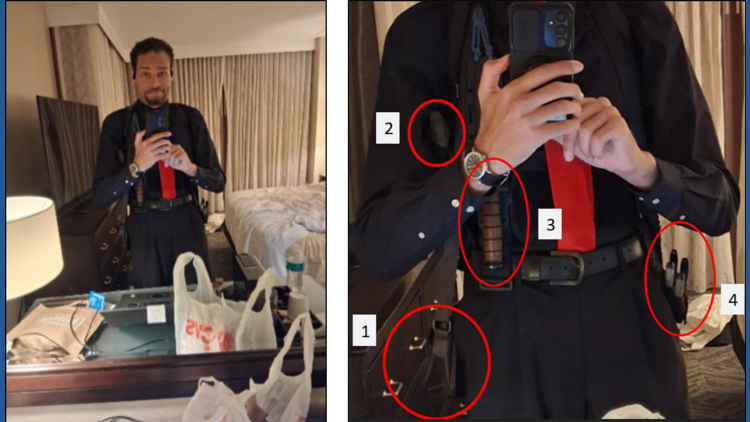
Authorities say Allen, who lives in Torrance, California, had been planning the attack and took a picture of himself in his hotel room just minutes before it happened, outfitted with an ammunition bag, shoulder gun holster and a sheathed knife.
In a message sent to family members minutes before the attack, the 31-year-old the described himself as “Friendly Federal Assassin” and railed against recent actions taken by the U.S. government under Trump, though he did not name the Republican president directly, according to a copy obtained by The Associated Press.
Allen’s federal public defender said he’s presumed innocent. His attorney is also attempting to remove several top Justice Department officials from the case, citing their close relationships with Trump and the fact that they were in the room when Allen allegedly tried to break in.
“When you’re impactful, they go after you. When you’re not impactful, they leave you alone,” Trump said at the White House press briefing two hours after the incident. “They seem to think he was a lone wolf.”
The government said he repeatedly made online checks to keep track of Trump’s status that night, including live coverage of the president exiting his vehicle at the Hilton hotel. Investigators said preset emails with an “Apology and Explanation” attachment were sent at approximately 8:30 p.m.
“He intended to kill and fired his shotgun while trying to breach security and attack his target. Put simply, the defendant poses an uncommonly serious danger to the community if released pending trial. The defendant’s lack of criminal history and other personal circumstances do not alter this conclusion,” Assistant U.S. Attorney Charles Jones wrote.
What happens at an arraignment?
Allen, like all defendants in the U.S. criminal justice system, faced a judge for arraignment, which is one of the first steps in a criminal trial.
U.S. District Judge Trevor McFadden, a Trump appointee, is presiding over the case. At the hearing, he is expected to read the charges against Allen and ask a few simple questions. Chiefly among them will be if Allen understands the charges against him.
Then, he will ask the question that many are familiar with: “How do you wish to plead?”
After the plea, McFadden will determine a schedule for the next stages of the trial as lawyers for the prosecution and defense prepare for the legal battle. Some criminal cases, especially high-profile ones that are as politically charged as the one against Allen, can take months before a jury is empaneled to hear the case.