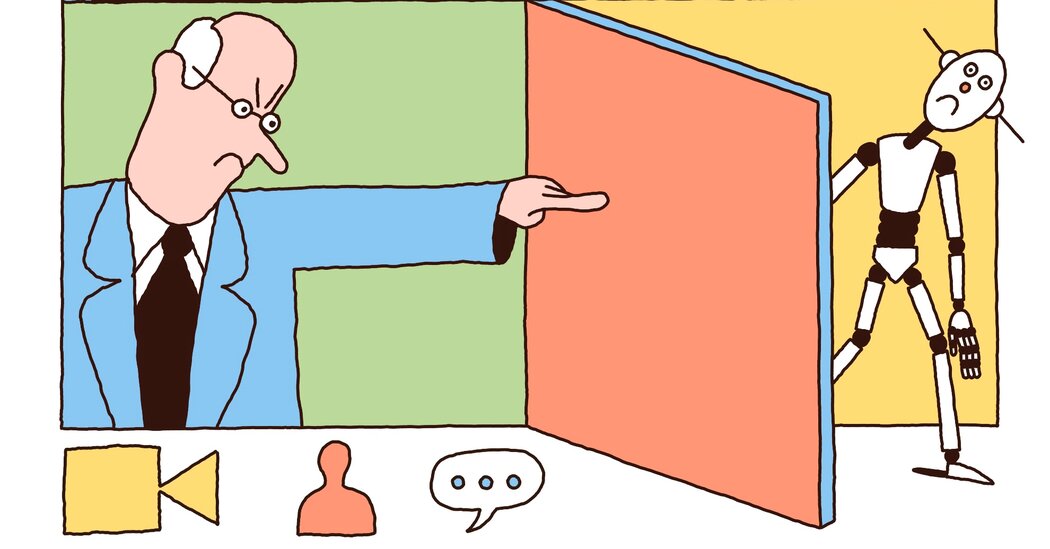
Jeffrey Gifford is a lawyer in San Antonio who specializes in corporate governance, securities and M&A at the law firm Dykema. In the moments before virtual meetings begin, he doubles as a bouncer.
“Before the meeting even starts,” he told DealBook, “when I see that A.I. note taker pop up, I’ll just say: ‘Hey, Mike, Jim, Barbara, I see the A.I. note taker popped up. I’m going to turn it off and kick it out of the meeting.’”
This happens more and more. “Everybody and their mother is using these things,” Gifford said. “Executives are using them, boards are using them, nonexecutive businesspeople are using them.”
Productivity powered by artificial intelligence is all the rage. Skipping meetings and sending an A.I. note taker instead has been called “the latest office power move.” Wallet-size recorders that use A.I. to log live interactions have become a product category. And at least one C.E.O. has endorsed the idea of adding an A.I. board member. (Maybe one programmed to behave like Warren Buffett?)
But to lawyers like Gifford, inviting an A.I. bot to meetings introduces a ticking time bomb of legal risk.
A.I.-generated transcripts, which some video call apps allow users to turn on by default, preserve all sorts of things — offhand comments, quickly corrected statements, jokes — that humans would rarely write in the meeting minutes. And they show up in meetings that would otherwise not be recorded.
In a lawsuit or an investigation, that can make every word uttered discoverable.
Even worse, say corporate lawyers: Sharing the meeting with an A.I. bot may void attorney-client privilege, making conversations that would not otherwise be subject to discovery fair game in a lawsuit.
Bot in the meeting
The New York City Bar Association issued a formal opinion on A.I. note takers last year, urging lawyers to “consider whether recording, transcribing and summarizing is tactically well advised in the particular circumstances” and to advise clients using such tools “of the disadvantages of doing so.”
One concern is accuracy. An A.I. transcript could, for example, record “does matter” as “doesn’t matter.” If that sentence comes up in court years later, the mistake may be difficult to remember.
Corporate lawyers also worry about A.I. note takers’ lack of context and discretion. For example, recording every word of a board meeting, no matter how tangential the remark, could be legally perilous.
“You want to make sure that the minutes, if they get into a courtroom, are going to not only be accurate but also are going to have the emphasis that the board would like,” said Doug Raymond, a partner at Faegre Drinker Biddle & Reath.
Worst-case scenarios are endless and easy to imagine. An executive talking through an acquisition may exaggerate, saying it would help the company “dominate” the category — a comment that could come up in an antitrust case. Or a board member could offhandedly acknowledge a risk that shareholders could later point to in a lawsuit.
“Typically, private litigation asks for all documents and communications related to a particular topic, so it’s not so much that a litigant needs to specifically ask for it,” said Christoffer Lee, a lawyer who focuses on corporate investigations and white-collar defense at the law firm Pillsbury.
Eventually, he expects to see more sophisticated litigants and government regulators ask specifically for these types of transcriptions.
“You’re just having to potentially address extraneous stuff that you otherwise wouldn’t have,” Gifford said.
Voiding privilege
Executives and corporate boards generally expect conversations with their legal team about legal matters to have attorney-client privilege. They lose that protection if they share the same information with outside parties — and it’s possible that an A.I. note taker could have the same effect.
Companies that make such tools, the argument goes, may have access to the transcripts and data related to them.
While courts have not directly addressed the issue, they’ve considered parallel questions.
In February, Judge Jed S. Rakoff of U.S. District Court for the Southern District of New York ruled that the transcripts generated with the Claude A.I. app when a defendant asked it for legal advice were not protected by attorney-client privilege. The judge wrote that the defendant could have no expectation of privacy when using a model trained on user inputs that made explicit disclaimers in its privacy policy about its ability to share with third parties (including with “governmental regulatory authorities”).
Judge Gershwin A. Drain of Federal District Court in Detroit took a different approach. She ruled, also in February, that a plaintiff who effectively represented herself in court could not be compelled to turn over her ChatGPT transcripts about the case. The judge rejected the argument that using ChatGPT was the same as disclosing to a third party.
Lee said these cases could be seen as analogous to the question of whether A.I.-generated notes from a legal meeting are protected by attorney-client privilege. “A.I. note-taking represents the next frontier,” he said.
As word of the risk spreads, Raymond said, his clients, especially public companies, have largely heeded the warnings: “Initially, I was seeing and hearing about it a lot, like: ‘Oh, this is great. Now I don’t have to worry about writing my corporate minutes.’
“But I think people have realized pretty quickly that it’s a bad idea. And so if they’ve gotten the word, they’re not doing it — or if they’re doing it, they’re not fessing up.”
IN CASE YOU MISSED IT
A panel of federal judges appeared to put new limits on President Trump’s trade powers. The U.S. Court of International Trade ruled that Trump’s 10 percent tariff on most U.S. imports, which he imposed after the Supreme Court struck down a previous set of tariffs, was also illegal. While the decision directly blocked the collection of tariffs from only the plaintiffs in the case, it could open the door for others to sue and weaken the president’s negotiating position at a summit with Xi Jinping, China’s leader, next week.
Job creation remained solid in April. Employers added 115,000 jobs last month, and the unemployment rate remained 4.3 percent. It was the second consecutive month of strong job growth after a stretch of slow hiring. Economists will be watching to see if the impact of high gas prices will temper the labor market’s momentum.
The White House considered more oversight for A.I. In a shift from its previously stance, the Trump administration is discussing a working group for government officials and industry leaders to discuss potential oversight procedures, which may include government vetting of new A.I. models. Google, Microsoft and Elon Musk’s xAI agreed to let a government agency examine their new models before they are released publicly.
Elon Musk and OpenAI faced off in court. Musk is suing OpenAI and Microsoft, OpenAI’s biggest investor, for $150 billion over claims that Sam Altman, the C.E.O. of OpenAI, defrauded him when Altman changed OpenAI from a nonprofit to for-profit company. Musk has been trying to make the case about human extinction, while OpenAI has sought to paint him as an unreliable narrator. Altman and Microsoft’s C.E.O., Satya Nadella, are set to take the stand in the next two weeks.
More big deals: Kalshi hit a $22 billion valuation. Samsung Electronics reached a $1 trillion valuation. And GameStop wants to buy eBay for about $56 billion. ABC accused the Trump administration of violating its free speech rights.
A reporter tests A.I. for everyday life
Artificial intelligence promises to make us richer, happier and more efficient. The journalist Joanna Stern decided to put that bargain to the test in her new book, “I Am Not a Robot: My Year Using AI to Do (Almost) Everything.”
A longtime personal technology columnist for The Wall Street Journal, Stern recently started her own media company. She spoke to DealBook’s Brian O’Keefe about depending on A.I., living with robots and raising kids alongside A.I. The interview has been condensed and edited.
Am I talking to the real Joanna or your A.I. agent?
I probably should have sent my agent, but this is really me.
Do you feel like a different person after a year of A.I.-maxxing?
Yes. Part of it is just this conditioning that I went through where every problem, whether personal or business, I was trying to solve with A.I. And so my instinct would quickly go to, “Let’s have A.I. do it!” I save a lot of time.
You tried limiting yourself to A.I.-generated music and literature. How was that?
My biggest takeaway is that if the person making the prompts doesn’t have an underlying understanding of music, or of what makes a good novel, these A.I. tools are not great. You need that intrinsic creativity and understanding of the medium. For music, I was prompting Suno to create a great running song that sounds like a pop song from the ’80s, and I just got crap back. It was truly just slop.
You interacted with a lot of robots in your research. How far away are we from humanoids in our homes?
I think the self-driving car is a great example. It took decades for it to get to where we are now. They needed to collect a lot of data of people driving to teach these cars how to drive. The same thing needs to happen in humanoid robots. They don’t have enough visualization and data on how to fold the laundry, how to clean the dishes, how to make the bed. The house is a very complicated place if you’re not a human.
You weave your family into the book. How are you thinking about raising kids in this evolving A.I. world?
My kids are younger, 4 and 8. One of the most important things they’re starting to learn is just to question the results. There were funny examples of that. I asked an A.I. to generate an image of a family of five hamsters for my son. And the A.I. kept saying there were five, but the picture showed six. The thing was just gaslighting me.
When you finished the book, did you do an A.I. detox?
I think I’d be scared to do that. A lot of habits formed over the year I was working on the book. I talk to ChatGPT in the car a lot, or sometimes when I’m on a walk just in the middle of the day. I wear the Meta Ray-Ban glasses all the time and ask Meta’s A.I. questions. I probably should just do the challenge of one day without using A.I. at work now and see if I remember how to write a really generic email. Is that something I’m still capable of doing? Do I know where to place commas? I think the answer is that I still know how to do all that stuff, but I don’t want to.
Quiz: A fight over ‘Avatar’
This question comes from a recent article in The Times. Click an answer to see if you’re right. (The link will be free.)
On Tuesday, the actress Q’orianka Kilcher sued James Cameron, the director of “Avatar,” and Disney, which controls the multibillion-dollar franchise. What did she accuse Cameron of stealing?
Thanks for reading! We’ll see you Monday.
We’d like your feedback. Please email thoughts and suggestions to [email protected].